
Diego Santillan
Co-Founder & COO
At CloudX, we spend much of our time talking with leaders of mid-market companies, and though each conversation is different, there is a shared concern: AI adoption.
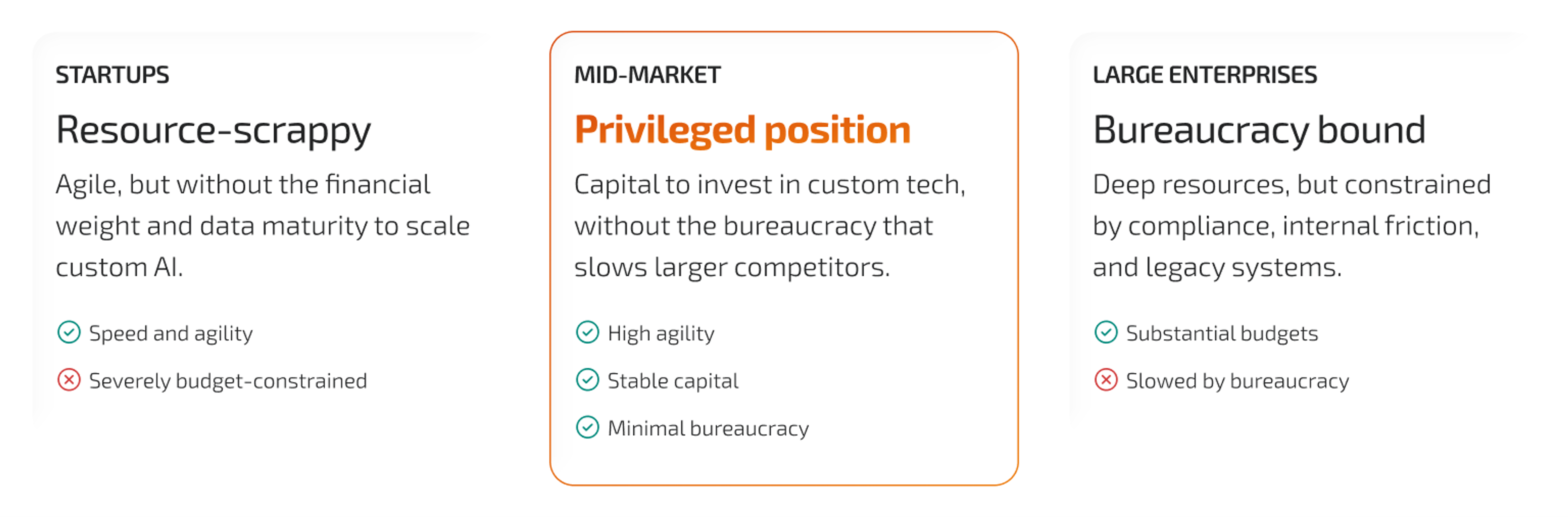
AI adoption in mid-market organizations is something counterintuitive. Companies in this segment hold a privileged position to adopt AI: they have enough financial weight to invest in technology seriously, rather than scraping resources together the way an early-stage startup must. And they are not buried under the layers of governance and internal politics that slow big enterprises down. However, they often have small technology teams and lack the capability to build AI solutions in-house, plus their data management frequently needs an update to fully harness the benefits AI can provide (e.g: decades of undigitized documentation on paper).
In our meetings with new clients, one of the most common cases is this: some people in the team have started using popular AI tools to speed up their work (Claude, ChatGPT, Gemini, to name a few). That is a good starting point for individual contributors to become familiar with AI and understand its capabilities and limitations. But those efforts are isolated, disconnected from each other, preventing that personal productivity boost from really impacting the business.
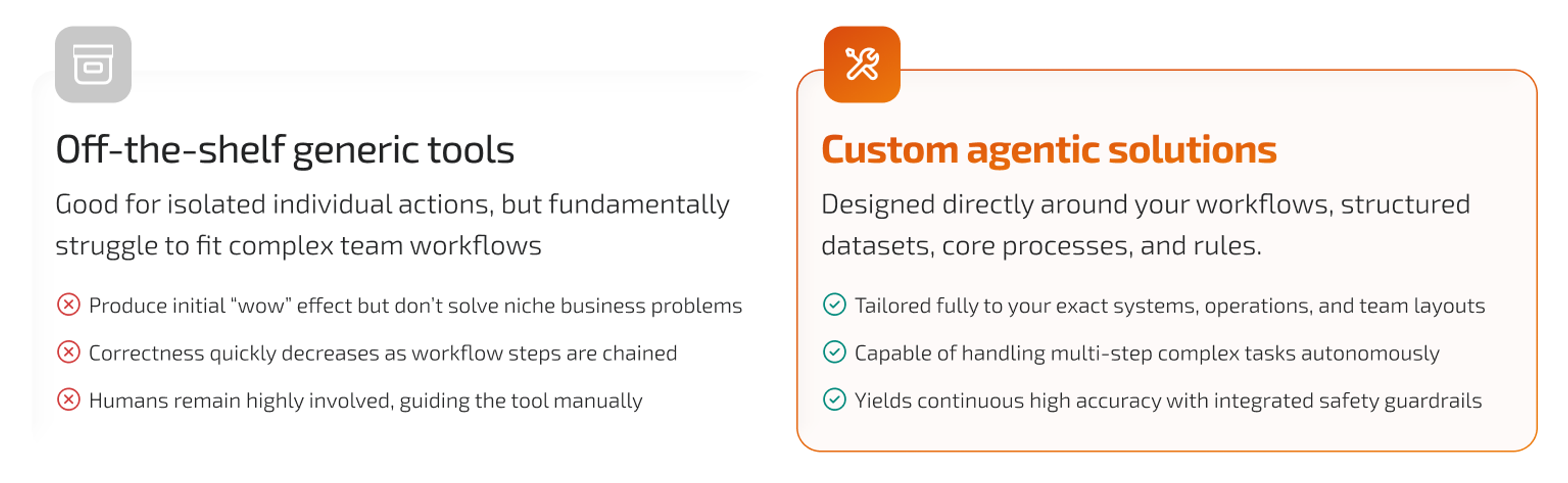
Furthermore, generic AI tools have limitations. You might have noticed this yourself: assign them a low or medium complexity task (for example, replying to an email, analyzing data pulled from different sources, reconciling entries between two systems, extracting key takeaways from a report), and they excel. But increase the complexity of the task, or chain multiple tasks that demand complex decision-making, and correctness begins to decrease. Besides, you, the human guiding the AI, are still very involved, limiting the amount of time you can actually save.
There is no silver bullet, but usually, the best way to tackle these challenges is a custom agentic solution, tailored to your specific needs.
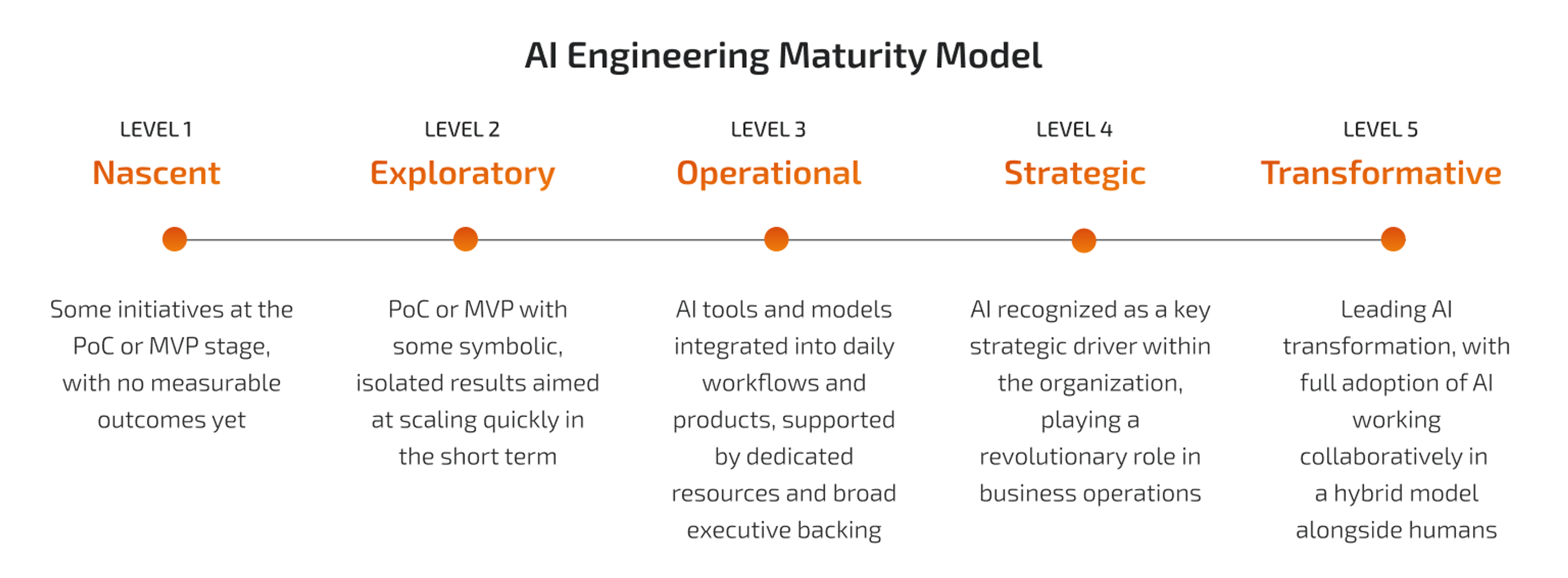
When we assess where companies actually sit on the path to AI maturity, the large majority of mid-market organizations land in the earliest stages, what we would call Nascent or Exploratory. They are experimenting at the edges, not yet running any meaningful part of the business with AI. Or maybe they are not even experimenting at all.
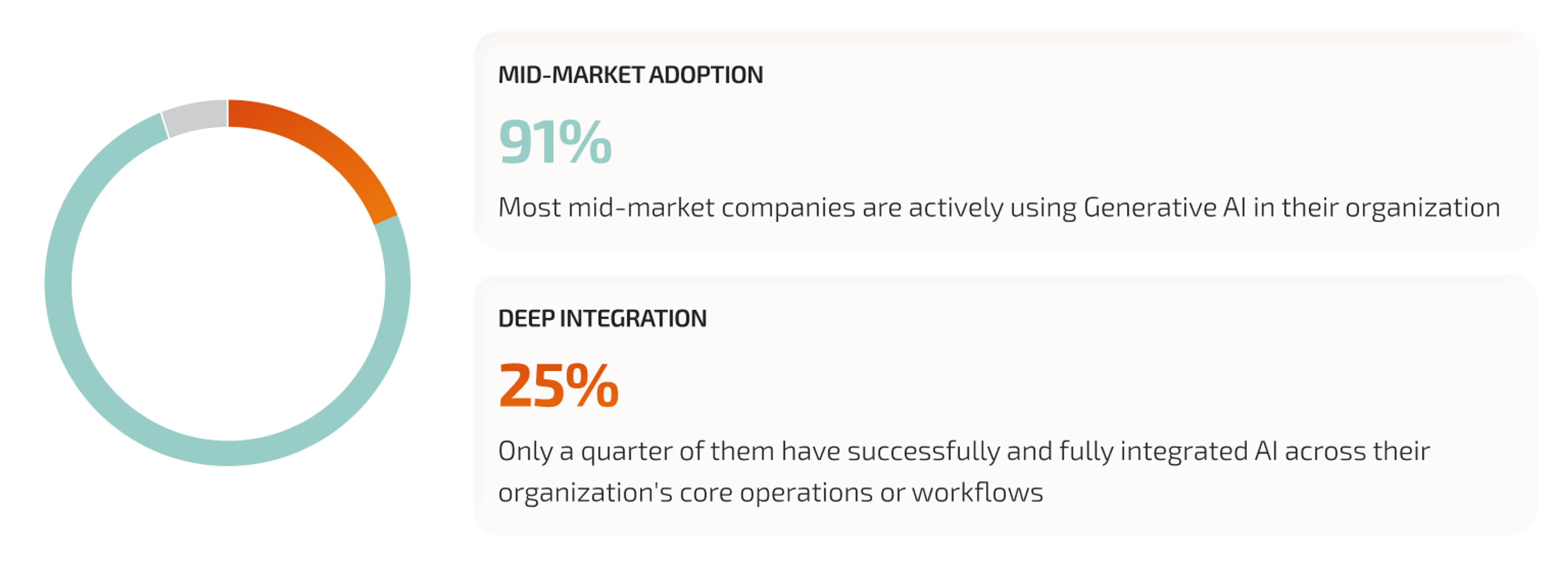
That fact can be read two ways. You can see the glass half-empty and treat it as a deficit, feeling behind. Or you can see the glass half-full, and take it how it really is: the companies you compete with, the ones your size, in your industry, under the same constraints, are sitting in almost the same place. The race you should be focusing on is not against the technology giants who started years ago. It is against your actual peers, and it has barely begun: A 2025 RSM survey of mid-market companies found that Gen AI adoption among them has surged to 91%, but only 25% have fully integrated it across the organization. Notably, a vast majority (92%) of those companies reported significant challenges during rollout, including data quality problems, security concerns, and skill gaps. More than half of respondents said they felt only “somewhat prepared” to implement AI, with another 10% feeling not prepared at all.
So instead of wondering whether you are late, your efforts should be directed to how to start well. Of course, this opens a different set of questions. Where to begin? What would be the optimal workflow to tackle first? If we run a test first, how can we be sure it will scale to real-life use? Will I burn my AI budget for the quarter in just a few weeks?
Fortunately, all these questions have answers, and they might be happier than you think.
When you make the decision to start investing in AI, the instinct is to think big, and worry about the budget at the same time. Yet, the most reliable way to begin is to pick one narrow, well-defined problem and use AI to solve it completely. Look for a process that is either critical to the business or painfully manual and repetitive, the kind of work that consumes hours every week.
Then, before you build anything, define what success would actually look like, and be precise. "Improve productivity" is not a target; it needs a metric. For example: “improve invoice processing from the current 9 minutes to 90 seconds or less”, or “cut the manual review step in a claims workflow by 80%”. The sharper your definition of success, the easier it becomes to judge whether the investment worked and to decide what comes next. Vague goals produce vague results.
Many organizations invest in off-the-shelf tools and call it an AI strategy. Sometimes those tools genuinely help, but even more often they help just enough to produce a “wow” effect while solving none of the problems specific to your business. MIT’s State of AI in Business 2025 report found the same pattern at scale: generic tools tend to stall inside organizations because they do not adapt to how a particular company works. The time and money you spend bending a generic product to fit your operation could have gone toward something built for your real problem, which is not the same as your competitor's. Your workflows, your data, your people, and your constraints are particular to you, and the solutions that change a business are the ones shaped around that particularity.
The other myth worth dismantling is that any of this demands an enormous budget. More spending does not always buy better outcomes, and some of the most effective work I have seen with our own clients came from modest budgets aimed squarely at the right problem. Choosing well matters far more than the size of the check.
So what do you do when you are convinced AI could help but honestly do not know how, or when you have heard the hype one too many times and doubt any of it applies to you? Closing your eyes, approving a large budget, and praying for the best is certainly not the right strategy. In this scenario, the best approach is: start by testing.
The smarter path is to validate the idea cheaply before committing real capital. Run a small, time-boxed experiment that answers the questions that matter: whether the idea is feasible with your data, and what a production version would genuinely require. This is the thinking behind a model we offer called AI Labs, fixed-price AI R&D delivered in weeks rather than open-ended engagements, built to give our clients evidence before they commit serious money. Still, the broader point holds with or without us: find a technology partner you trust enough to let them get deep into your business, so that what they propose is built for you rather than sold to you.
One caveat. If much of your operation still lives on paper or in disconnected spreadsheets, AI will help only at the margins until you address some digital transformation first. That is not a reason to wait, but a reason to choose a partner who can also bring the data engineering capacity to get your foundation right.
The state of AI for the mid-market in 2026 looks more like a starting line than a finish. Organization-wide value is still rare, which means the distance between the two is where the next few years of advantage will be decided. For a mid-market company, being early is not the liability it can feel like. It is an opening, as long as you treat the first move as small and deliberate rather than a leap of faith. Start small, with a clear definition of success and a partner who takes the time to understand your business and recommend the best solution for your unique challenges. That is a reachable place to begin, and it is available to you right now.

Success Case
CloudX AI Labs designed the AI architectural foundations for JEN, Mainspring Energy's agentic diagnostic system for linear generators. In three weeks, the…

Service
AI Labs delivers R&D-as-a-Service through fixed-price, easy-to-buy consulting packages so you can invest in AI with confidence.

Insights
The only constant is change. In life, and also in the world of Generative AI. Advances in AI can render many tools and solutions that are only months old…