
Nahuel Vigna
Co-Founder & CEO
Software development has a new constraint, and most organizations have not yet named it. It is the problem that will define competitive advantage in enterprise software delivery in the years ahead.
For the past two years, the dominant narrative around AI in software development has been about speed. Models generate code in the blink of an eye, agents close pull requests autonomously. Therefore, teams deliver more, faster, with fewer people. The industry celebrated a dramatic reduction in construction cost, and everyone calls this ”transformation”.
It is a partial truth. Yes, the construction cost did fall, but the bottleneck did not disappear. It just moved upstream, into the one stage that AI cannot automate. At CloudX, we observed this in our own teams before we did anywhere else.
CloudX has been building GenAI systems for enterprise clients since 2022. When AI-assisted code generation became genuinely capable, we watched something counterintuitive happen. Our engineers were faster, but they soon hit a wall that had always existed, hidden beneath the slower pace of traditional delivery: the definition phase. The moment when someone has to decide what to build and why.
The dominant model of software development requires exhaustive documentation before work begins: user stories, acceptance criteria, approval chains... A system built for a world where construction was expensive and rework was a risk.
Recently, Sundar Pichai confirmed that 75% of all new code at Google is generated by AI, which seems to hold across the industry. So, the bottleneck has shifted from building quickly to defining quickly what needs to be built.
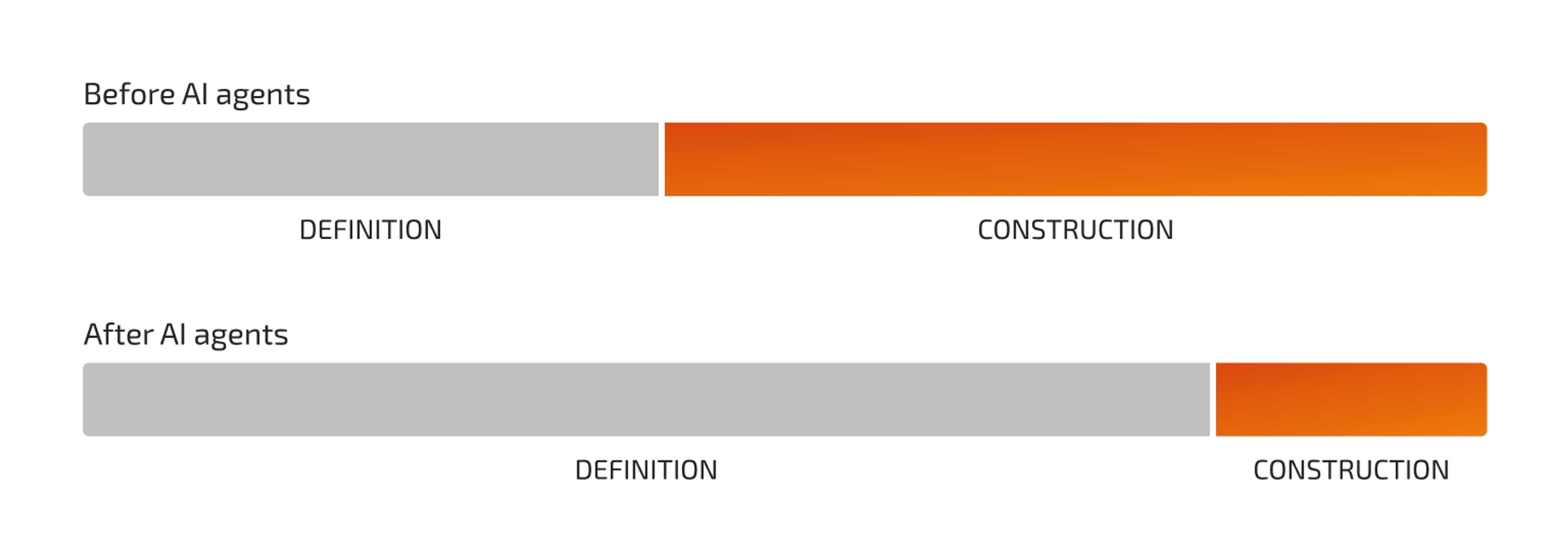
Traditional enterprise Agile was designed for a world where developer hours were the scarcest resource. The methodology made sense under those constraints. And rework, in a world of expensive construction, was a cost failure.
AI has shifted the paradigm. As code generation cost gets lower and lower, rework is no longer a risk: it becomes a powerful tool. Multiple variations of a single feature can be built in parallel (as prototypes or even as fully functional software) and presented to stakeholders for immediate evaluation. The feedback loop compresses from weeks to hours or days.
AWS frames this explicitly: planning must become intent design, where teams define goals, constraints, and expected behaviors rather than documenting every decision path. The underlying assumption of Agile, that the software being delivered is deterministic and testable against fixed criteria, no longer holds when AI is embedded in the delivery process itself. Steve Jones of Capgemini has argued that AI agents building applications in hours have effectively rendered the Agile Manifesto obsolete, as its human-centric principles were not designed for an agentic software development lifecycle. Those are significant claims from some of the industry's largest organizations.
At CloudX, we believe it’s time that Agile and the practices built on top of it are rebuilt from the ground up.
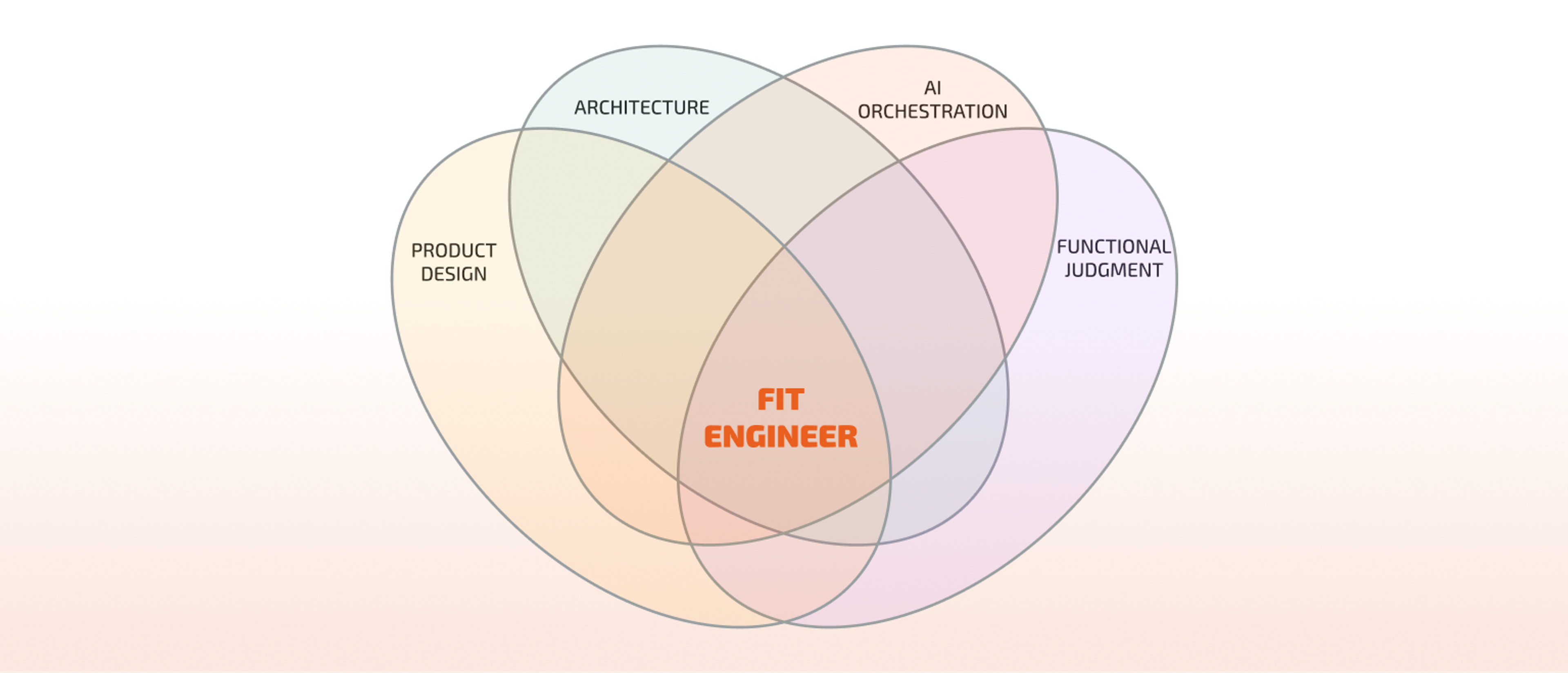
The methodology we developed and now deploy for enterprise clients is called Fast Impact Teams (FIT). The premise is simple: as AI absorbs the construction cost, the engineer's cognitive capacity should not just migrate toward QA. It should concentrate upward — toward architecture, functional judgment, and product design.
A FIT unit begins with a high-level business intent, not a requirements document. Senior System Engineers use AI to proactively map logic, identify edge cases, and begin building from the first iteration. Definition emerges through the build, not before it. Then, stakeholders interact with working software within days and make decisions grounded in working reality.
The key design choice is who sits inside a FIT unit. Every engineer is a Senior System Engineer, selected and evaluated on agency. They have the experience and the ability to take a high-level business objective, architect a path forward, and own the functional outcome without being handed a specification. That is a different kind of engineer than the executor model that dominated the previous era. It is a fully-fledged Product Engineer. Someone who operates at the intersection of business intent and technical execution.
Of course, governance matters as much as velocity. Fast Impact Teams is not vibe coding at enterprise scale: robust architecture, security, and scalability are enforced at every stage by the same engineers driving the build. AI operates as a high-velocity execution engine under strict human oversight. The result is startup speed with enterprise reliability.
The organizations that capture the most value from agentic software development will be the ones that redesign the delivery process itself. That starts with fundamental questions: who does the work, how the work is defined, what governance looks like when construction is no longer the primary constraint.
A critical metric is cycle time. How long does it take to move from a business objective to working software that a stakeholder can evaluate? In an AI-driven operating model, if that answer is still measured in months, the bottleneck is methodological. And the fix is a new way of working.
The world Agile was designed for no longer exists. What replaces it is not just a faster process. It is a different kind of engineer: one whose potential is no longer constrained by the fear of rework, by passive execution, or by the weight of documentation that precedes every decision. The methodology is going to change. Will your organization be the one redesigning it, or the one adapting to someone else's version?

Service
AI Labs delivers R&D-as-a-Service through fixed-price, easy-to-buy consulting packages so you can invest in AI with confidence.

Insights
Most AI investments stall before they reach production. This article examines why the pilot trap persists across enterprise, mid-market, and small companies…

Insights
In 1955, British historian Cyril Northcote Parkinson observed that "work expands to fill the time available for its completion". Originally a critique of…