
Erik Davidsson
Head of AI
The numbers are striking: enterprise spending on Generative AI reached $37 billion in 2025, a 3x increase from the prior year. And yet, according to Deloitte's 2026 State of AI in the Enterprise report, only 34% of organizations are truly reimagining their business with AI. The rest are stuck somewhere between surface-level exploration and limited process redesign.
This gap between enthusiasm and real impact is the defining challenge of AI adoption today. Frequently, what separates leaders from laggards is the organizational capacity to move from small isolated improvements to a production system that delivers value across the organization.
At CloudX we see this situation every day. Many of our clients had previous attempts at adopting AI that went like this:
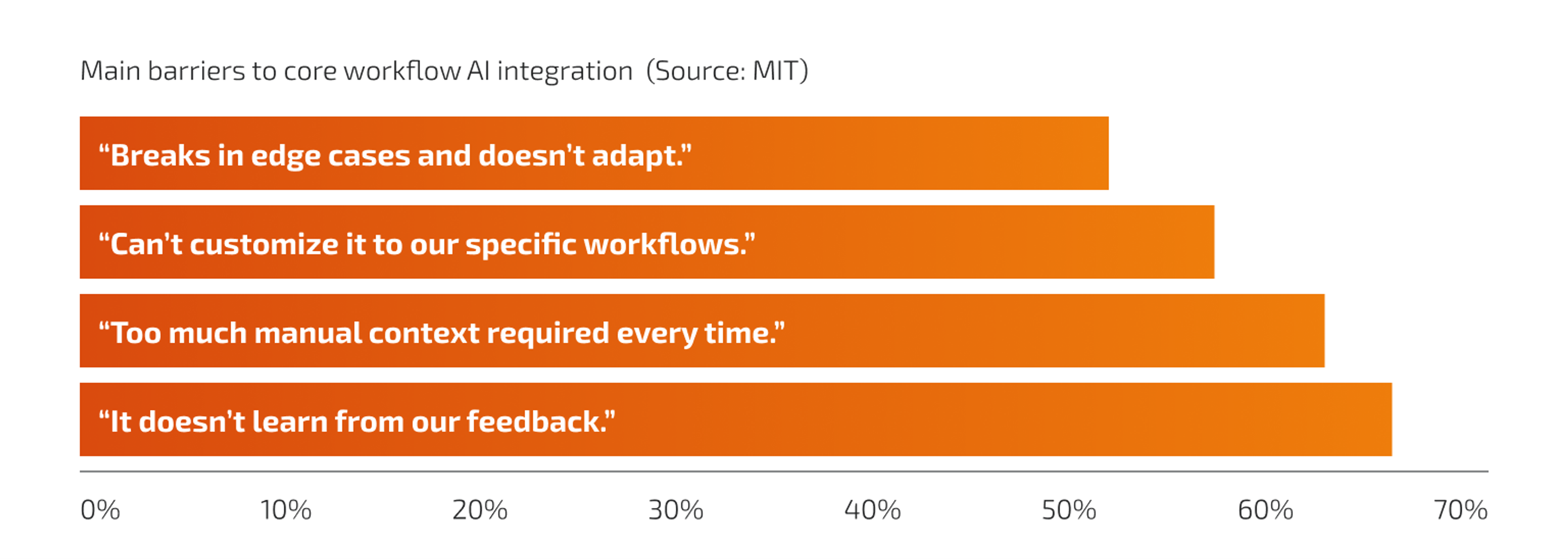
This is what the industry calls the “pilot trap”. A popular 2025 report by MIT's Project NANDA explains that the primary factor keeping organizations far from true transformation are generic tools that don't learn, integrate poorly, or don’t match real workflows. In consequence, users abandon them, and the pilot fails.
What's missing is systems that adapt, remember, and evolve. According to the MIT, the organizations pulling ahead are deploying better-integrated tools that are embedded directly into the workflows where decisions get made.
One of the most common pain points we hear from clients is the inability to budget accurately for AI projects. Traditional project sizing does not work well for AI, because LLMs behave non-deterministically. Many organizations have been burned by open-ended engagements that expanded well beyond initial projections. Additionally, data gaps that seem manageable in a controlled environment become critical blockers in production. The cost of discovering these constraints late is high, both financially and organizationally.
Different types of companies are experiencing this challenge in very different ways.
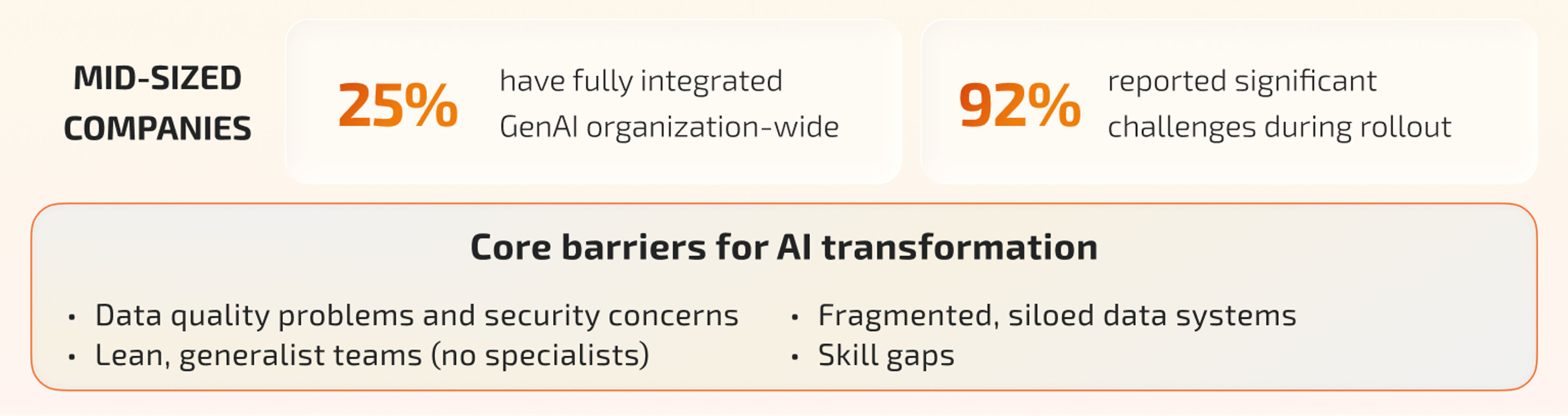
Large enterprises usually have the resources to invest in AI at scale, and many have done so aggressively. According to Microsoft, 80% of Fortune 500 companies are actively using AI agents. But size is not a guarantee of success. The same organizational complexity that gives enterprises their competitive muscle tends to make adoption slow and fragmented: legacy infrastructure creates significant integration barriers, and regulatory and governance scrutiny is high. The cultural dimension is equally consequential. Only 20% of enterprises currently have a mature model for overseeing autonomous AI agents. Internal resistance and inadequate training usually derail initiatives even in organizations with state-of-the-art tooling. According to Deloitte, upskilling became the primary way companies adjusted their talent strategies in response to AI.
The gap between deployment and value creation remains unresolved for most enterprises. Those that do close it share a common trait: senior leadership that actively shapes AI governance, rather than delegating the work to technical teams alone. The lesson is that successful AI adoption is not primarily a technology problem — it is a people problem.
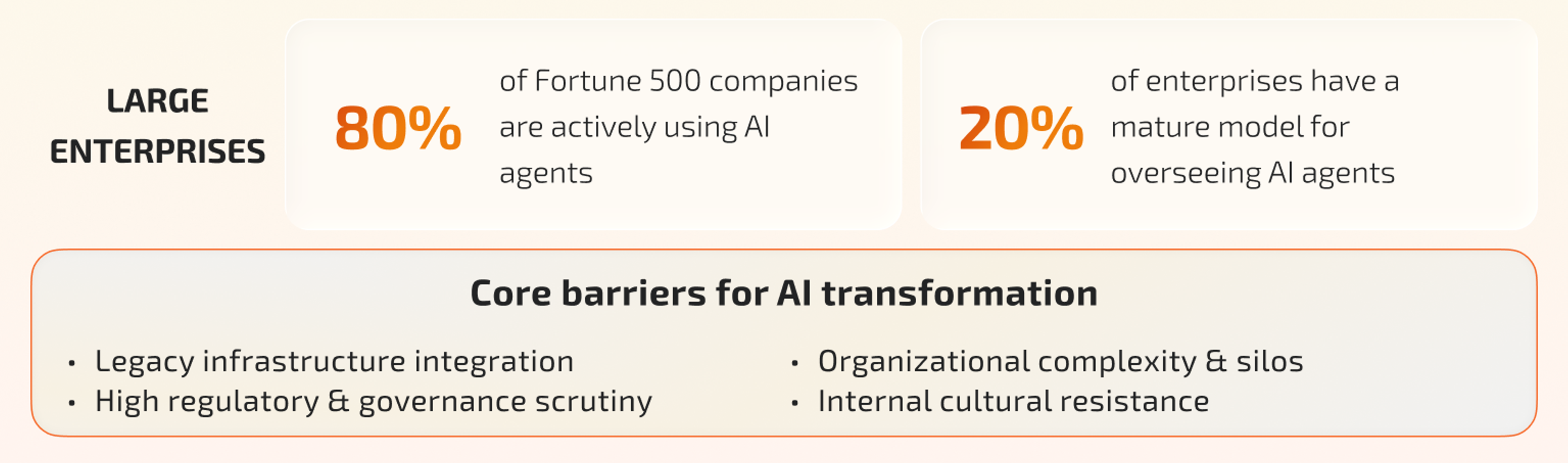
At the other end of the spectrum, small companies and startups benefit from a structural advantage: speed. MIT research found that top-performing mid-sized and small organizations moved from AI pilot to full implementation in an average of 90 days, a pace rarely matched by large enterprises. However, AI adoption is consistently lower among small companies than enterprises. Company age apparently plays a key role as well: according to OECD data, startups and newer businesses adopt AI at meaningfully higher rates than established small businesses. It seems that when the organizational culture is built from the ground up around modern tooling, there is less friction.
The constraints for small companies are different, not smaller. Budget is the obvious one, but access to expertise is often the deeper problem. Even among those who do adopt Generative AI, 71% use it for isolated tasks rather than core business processes.
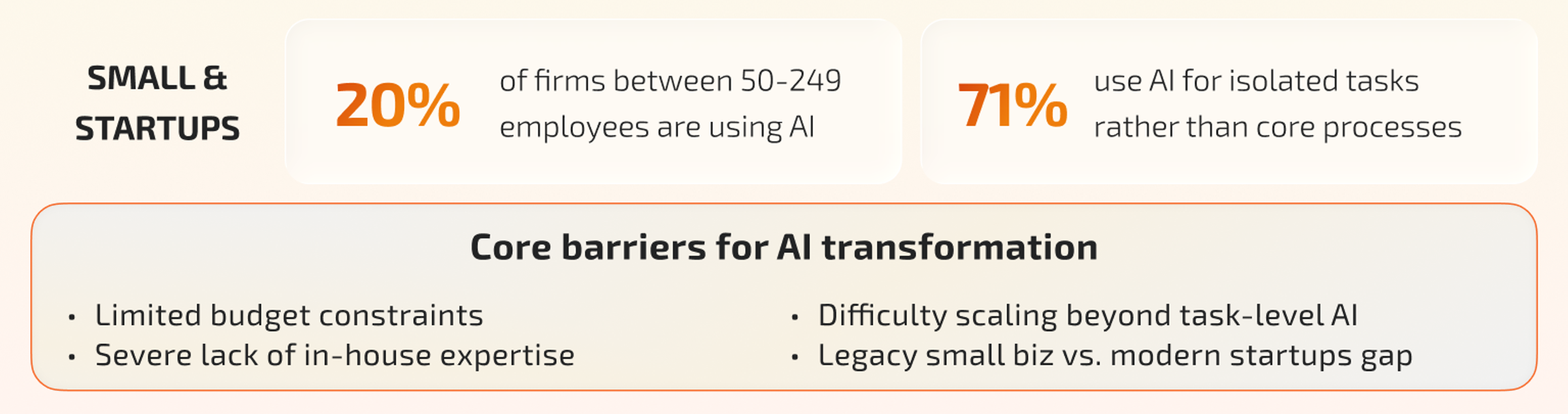
Mid-sized companies occupy the most complicated position in AI adoption. They are too large to move like startups, and too constrained to operate like enterprises. Usually, they feel the urgency to modernize, but lack the infrastructure and specialist talent to do so. The numbers make this visible: a 2025 RSM survey of middle market companies found that Generative AI adoption has surged to 91%, but just 25% have fully integrated it across the organization. 92% of those companies also reported significant challenges during rollout, including data quality problems, security concerns, and skills gaps. 53% of respondents said they felt only “somewhat prepared” to implement AI, with another 10% not prepared at all.
These barriers are predictable but difficult to solve. Mid-market teams are typically lean and generalist—there are rarely in-house data scientists, ML engineers, or AI architects. Data infrastructure is often fragmented across systems that were never designed to work together. And when a pilot fails (as 95% of AI pilots do, according to the MIT), the organization often lacks the knowledge to understand why. Mid-market companies are also the segment most likely to invest in off-the-shelf AI tools that improve individual productivity but do not reshape workflows or drive organization-wide returns. The result is a growing divide between companies that are genuinely transforming and those that are just running expensive experiments.
At CloudX, we designed a service especially to break this cycle. The philosophy behind AI Labs is straightforward: before an organization commits significant capital to building an AI solution, they should have evidence about what is technically feasible, what the data requirements actually are, and what a production path realistically looks like.
This matters across all company sizes, but matters most for mid-market companies that often can’t absorb the cost of failed AI experiments that waste budget, consume political capital, and narrow the window for competitive differentiation. We built AI Labs because we believe mid-market companies deserve access to the same quality of AI R&D that powers the world's largest enterprises, without the prohibitive costs or multi-year commitments that have historically made that level of expertise inaccessible. Our fixed-price model makes enterprise-grade AI experimentation both affordable and risk-free, ensuring our clients can explore AI's potential in their specific context and accurately size the project before significant investment.
Here are some frequent pain points that can be solved through AI Labs.
A recent engagement illustrates how this plays out in practice. Mainspring Energy, a California-based clean energy company, came to AI Labs with a well-defined problem but no clear path to solve it. Their internal AI diagnostic tool was generating high token costs, struggling with context overload, and running on an architecture that had grown without a coherent long-term direction. They knew what they needed, but they did not know how to get there.
CloudX conducted a deep technical immersion onsite, mapping the software's full architecture, auditing integration points, identifying evaluation gaps, and surfacing the token cost drivers. The engagement delivered a current-state architecture document, a future-state agentic system design, a defined evaluation and observability framework, and a cost-aware implementation roadmap built around a scalable multi-agent approach. The outcome exceeded expectations. Mainspring left empowered with enough clarity and confidence to execute the build themselves, which is exactly the outcome AI Labs is designed to produce.
We like being equally clear about when AI Labs is not appropriate for a client’s situation. These are some of those cases:
We encountered this situation recently with a prospective client. A logistics company approached us wanting to automate their freight invoice reconciliation process using AI. They had a clear use case and were ready to move fast, but their expectations for the engagement included a fully deployed, compliance-ready system by the end of it: security hardening, audit trails, integration with their ERP, and a solution their operations team could rely on in production from day one. AI Labs was not the right fit. Those are production delivery requirements, and the lab phase is not designed to meet them. We were transparent about that upfront, rescoped the engagement as a full delivery project with the appropriate timeline and team, and built the solution to production standards.
The state of AI adoption in 2026 reflects a genuine inflection point. Enterprise spending is surging, adoption rates are climbing, but the gap between deployment and meaningful business impact remains wide, mostly because the path from pilot to production is harder than most organizations anticipate.
For mid-market companies especially, that gap carries real competitive risk. The organizations that close it are not the ones with the largest AI budgets or the most ambitious roadmaps, they are the ones that invest early in understanding what is actually feasible for their specific context, data, and constraints.
If your organization is weighing an AI initiative and is not yet sure what it would take to get to production, that uncertainty is exactly the right starting point for AI Labs. Our goal is to give you the evidence you need to make the right call (whatever that turns out to be).
Learn more about CloudX AI Labs at cloudx.com/services/ai-labs.

Insights
This is not the typical “2026 AI trends” article. As Generative AI evolves and the hype grows, many assume the era of experimentation is over. But our…

Insights
The only constant is change. In life, and also in the world of Generative AI. Advances in AI can render many tools and solutions that are only months old…

Service
AI Labs delivers R&D-as-a-Service through fixed-price, easy-to-buy consulting packages so you can invest in AI with confidence.