
Pablo Romeo
Co-Founder & CTO
Sometimes, a client approaches us not with a need to build something new, but to maintain software that already exists. A substantial share of the world's most critical software is not new: it runs in the background of hospitals, logistics operations, financial institutions, and manufacturing lines. It might be many years old, but it is robust and reliable, and it performs exactly the function it was built for. The companies that depend on it are looking for someone who can keep it alive and extend it thoughtfully without risk.
In this segment of the market, AI agents are producing some of their most compelling results.
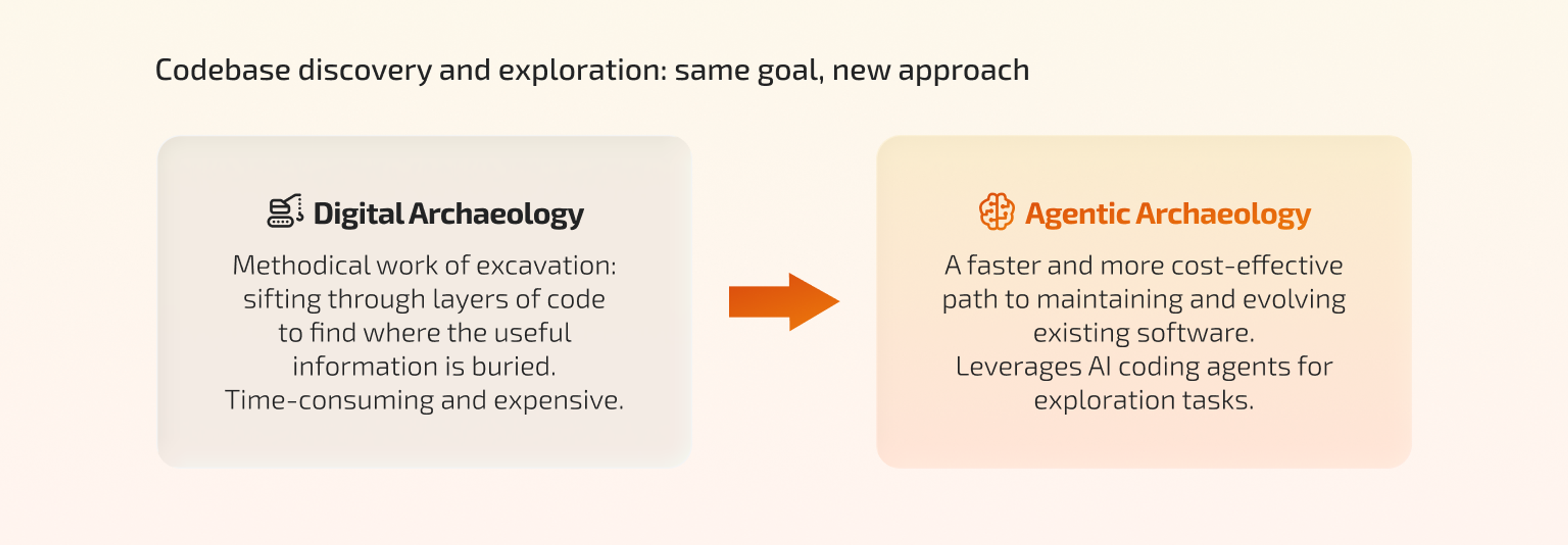
In our early days we formalized a specific software maintenance service consisting of stepping into existing codebases with no documentation and no knowledge transfer, and figuring out what was there. We called it Digital Archaeology, and it was built on the methodical work of excavation: sifting through layers of code to find where the useful information was buried.
This methodology was built on a genuine scarcity. Senior engineers capable of reading an unfamiliar codebase, tracing its logic, mapping its dependencies, and forming a reliable mental model of its behavior were rare. The value we offered was in finding those engineers, training them in a structured investigative process, and deploying them on projects where nobody could tell how the software worked. Usually, the kind of project where all the foundational developers had already left the company, and there was no one to do a knowledge transfer after engaging with us.
Digital Archaeology was a real differentiator then, because this problem is more common than it seems. Legacy software usually accumulates decisions made under constraints that no longer exist (or nobody remembers), by people who are no longer available, maybe in languages and frameworks that have not been mainstream for decades. Getting up to speed was slow, expensive, and dependent on talent that was very hard to find.
That scarcity no longer exists, or at least not in the same form. AI coding agents have compressed the onboarding curve, and the implications for Digital Archaeology as a service are significant.
In large organizations, it is common to find systems that only one or two engineers know inside and out. Usually, that knowledge is not documented, and it just lives in their minds: why a particular workaround exists, what the system does under edge conditions, where the fragile parts are. But what happens when those people leave the company?
AI coding agents can be especially helpful in that scenario, but it is worth being precise about what agents are good at, and what they are not. In their current state, agents perform best at writing new code on greenfield projects: new builds of small to medium size, where the codebase is clean, dependencies are modern, and the agent can move with confidence. But legacy systems are a different environment. Decades-old codebases with outdated frameworks and layers of accumulated decisions are harder for agents to navigate reliably. Deploying an agent to freely implement features in that context carries real risk. Where agents do excel in legacy work, and where they add considerable value, is in exploration. Mapping the codebase, surfacing what is there, generating documentation, and answering the foundational questions that make any subsequent work possible.
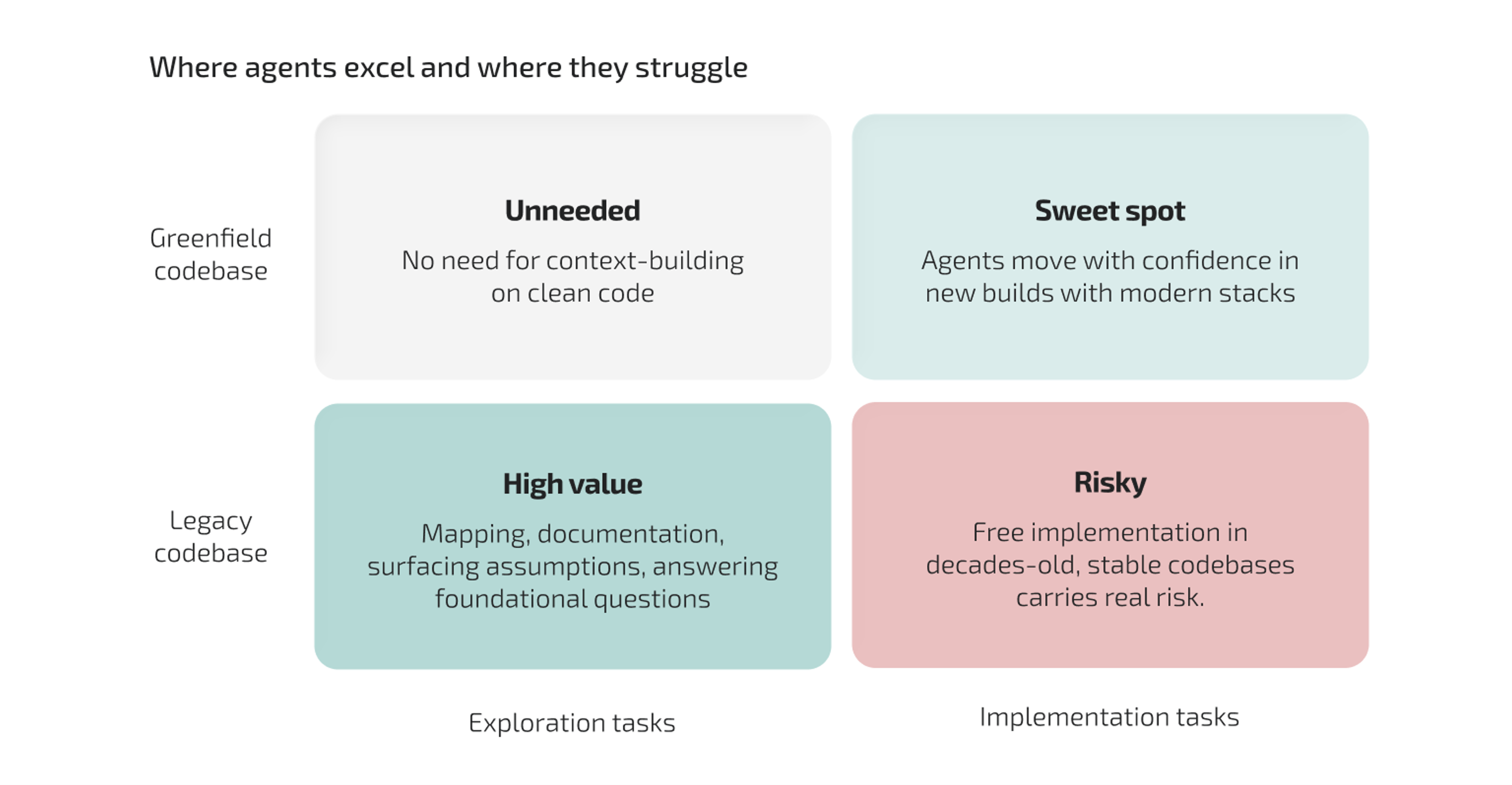
Coding agents, including Claude Code, Codex, and Cursor, can analyze the full structure of a project and build a working understanding of how it behaves, in a fraction of the time it would take a human engineer working alone. They can map dependencies, identify where business logic lives, surface undocumented assumptions, and plan an implementation approach before a single line of code is changed. Multi-repo support also enables agents to understand dependencies across complex, distributed system architectures, which is particularly useful for enterprises running systems that span multiple codebases accumulated over decades.
For open-source codebases, tools like DeepWiki (powered by Cognition’s Devin agent) take this further: the engineer gets an automatically generated wiki with architecture diagrams, module summaries, and a conversational interface for asking detailed questions about the codebase. Thanks to these advancements, the learning curve that used to require years of hands-on time on a specific project can be compressed significantly.
However, the human engineer's role in legacy work remains consequential and demanding. Modifying a system that has run reliably for years, without introducing new risk, requires judgment that no agent can substitute. What changes is how quickly an engineer can reach the point where that judgment can be applied.
New applications will always attract attention, but software that has been running without interruption for ten or fifteen years carries a different kind of value: the trust of the people who depend on it daily. That is an asset to protect.
The underlying client need that Digital Archaeology served has not disappeared. The discipline is now evolving into Agentic Archaeology, a faster and more cost-effective path to legacy software maintenance and evolution, without the weeks-long ramp time that kind of work used to require.
Agentic Archaeology has a direct consequence for organizations considering a change in their technology team. Organizations looking to replace their vendor or development team would often hold back because of how difficult the transition used to be. Bringing in a new team with no knowledge transfer and no documentation was risky. But now, it is different. The accumulated hands-on time a team has with a product is no longer the advantage it once was. A new team equipped with the right agentic tooling can reach a comparable level of understanding in a fraction of the time, making transitions that once felt prohibitive considerably more viable.
Organizations that rely on legacy software still need partners who can work inside complexity, make responsible decisions about what to touch and what to leave alone, and deliver changes that do not introduce new risks. The new must-have skill is judgment: knowing how to deploy agents effectively in high-stakes systems and how to validate what they produce.

Insights
The only constant is change. In life, and also in the world of Generative AI. Advances in AI can render many tools and solutions that are only months old…

Insights
AI did not eliminate the bottleneck in software development: it relocated it. Construction cost has collapsed, but the definition phase remains a human…

Service
AI Labs delivers R&D-as-a-Service through fixed-price, easy-to-buy consulting packages so you can invest in AI with confidence.