
Nahuel Vigna
Co-Founder & CEO
Every major technology wave arrives with a chorus of people promising it changes everything. In the AI boom, it was louder than ever before.
The most dangerous pitches around AI claimed that expertise had become optional. Point the tools at a problem and they would handle the rest, no deep background required. A lot of vendors sold that story, and a lot of companies reasonably believed it. Because when the people who are supposed to understand a technology tell you it works a certain way, you trust them.
There were more measured voices in the mix pointing out that this was moving faster than the technology could really support. Let’s remember: AI is still a young technology. We are still learning what it can do, what it excels at, and where it performs poorly. That reality was easy to miss in the rush, so the market did what markets do with a compelling promise: it moved fast. Teams started shipping quickly, leaned into “powered by AI” as a signal of progress, and in the rush a fair amount of AI-washing passed for strategy.
Now, the consequences are showing up. Some companies watched their token spend climb into numbers they had not budgeted for. Others found that applications that worked well in a demo started to crumble once the real users arrived: security gaps, systems that would not scale and a large list of unexpected issues.
However, it is not always black or white. AI genuinely opens doors that were closed before. Not only that: AI creates doors that did not exist, opening to possibilities we could not even dare to imagine before. What it does not do is remove the need to work through hard problems methodically, with someone involved who understands what is actually being built.
In early 2025, Andrej Karpathy introduced the term “vibe coding”: building software by asking AI what you want in plain language and forgetting code exists. Vibe coding is a very popular approach to building software, and it is how a lot of products get off the ground quickly. Even big enterprises are vibe coding their way into production.
But there is a line worth drawing between vibe coding and AI-assisted development. If AI writes the code but a developer reads it, tests it, and understands the decisions behind it, that is AI-assisted development, and it is how serious engineering teams now build. In contrast, vibe coding is skipping that part: judging the result by whether it looks right rather than by understanding how it works, and accepting most of what the agent produces without reviewing it closely. Unfortunately, this is how many companies are building software right now, and the consequences are starting to show up.
AI works like a multiplier. An experienced software engineer using AI can multiply the good work they already do, several times faster. They can move into technologies they had not used before, prototype in hours, clear the routine parts of the job that used to eat their week.
Here is the paradox: the same tool, at the fingertips of someone without the underlying software engineering skill, is still a multiplier. Except now it is amplifying their inexperience, scaling knowledge gaps and poor judgment just as fast. The tool is identical in both cases, but the result depends on who is directing it, and on how much they understand about what they are asking for.
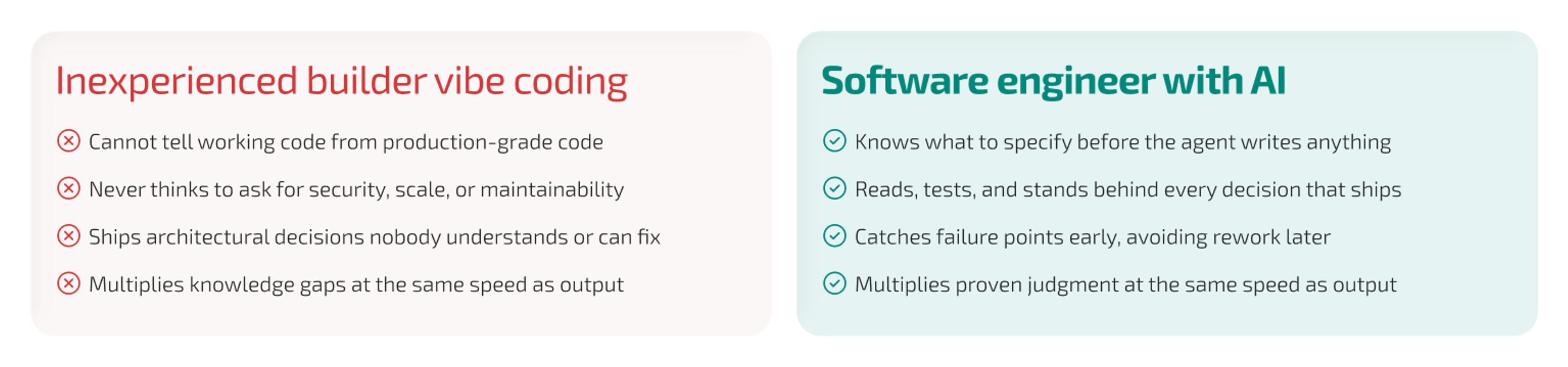
When AI is used to build enterprise systems by someone without a strong engineering background, the resulting code might run in a demo, but it will be a long way from enterprise-grade software. That means software that survives contact with production conditions, where security, privacy, scale, maintenance, and long-term cost are not optional. A builder lacking actual software engineering experience has no way to tell the difference between code that works and code that meets high quality standards, because spotting the gap is exactly the part that requires the experience they do not have.
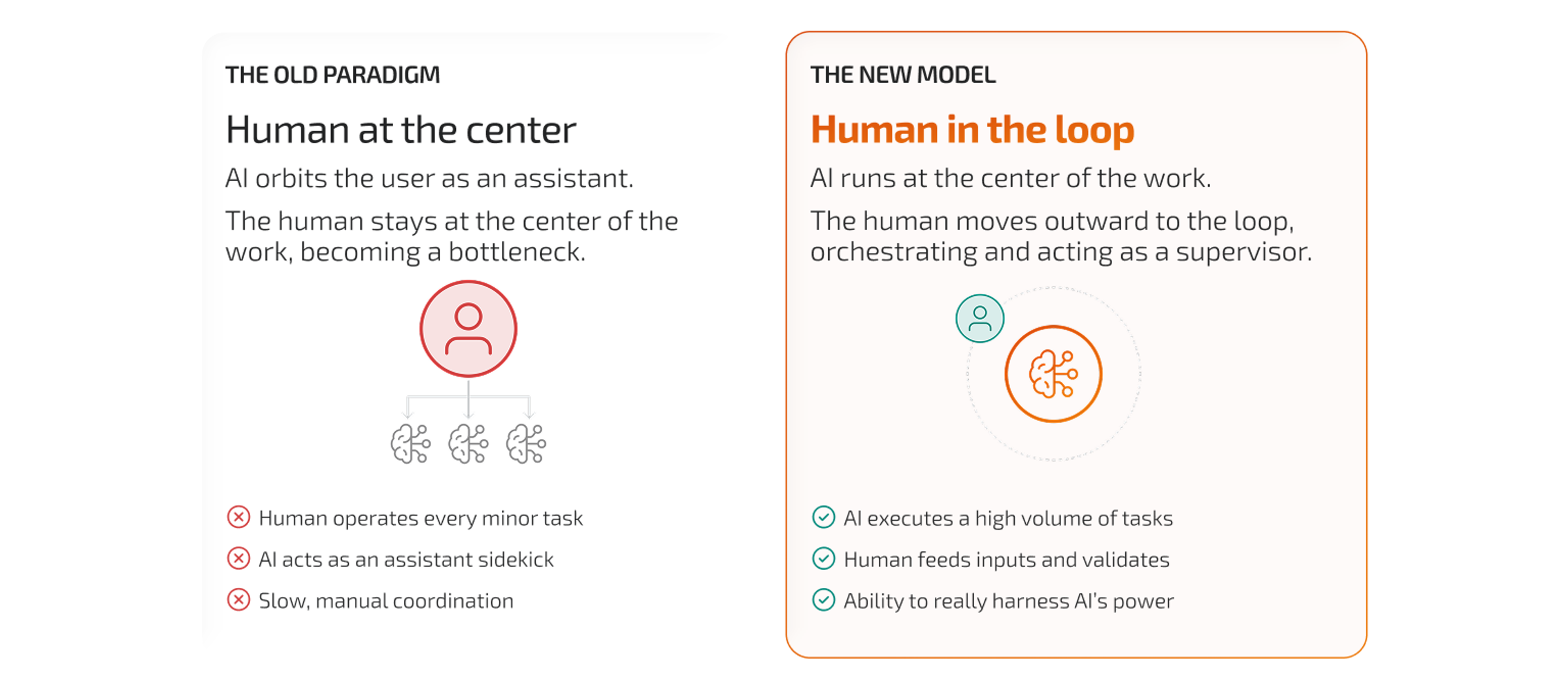
However, this does not mean that we should step away from AI and vibe coding. Instead, we should ask ourselves: where should we sit while AI runs?
There is a lot of room between putting a person at the center of every task, where they become the bottleneck, and handing the system full control, where no one is accountable for what it produces. The healthiest position is in the loop: close enough to direct the work, supply the right inputs, catch what the system gets wrong, iterate, and sign off on the product of AI and human judgment combined.
Vibe coding went wrong where “human in the loop” was read as optional instead of active supervision by someone who knows how the work should be done. Supervising a system that does the work does not take less skill than doing the work yourself. It takes more.
Employment data is starting to reflect this. A 2025 study from the Stanford Digital Economy Lab, “Canaries in the Coal Mine?”, found that early-career workers in the occupations most exposed to AI (software engineering among them) saw a 13 percent relative decline in employment since late 2022, while more experienced workers in the same roles held steady or grew. The same research found that people who used AI to check and refine their work held up better than those who handed whole tasks over to it.
While AI models become a commodity, the value moves to the operating system and the human judgment built around it. Architecture, guardrails, a review process, and the people who know what good looks like. An AI agent optimizes for the request in front of it, but it does not natively carry a stake in non-functional requirements—scalability, security, maintainability, observability, the qualities that decide whether a system survives contact with the realities of production. Someone has to watch over that, and it should be a person who understands what production-grade actually demands. Delegate that judgment to the agent, and you are trusting a system with no visibility into your business or your future roadmap to make architectural calls it was never positioned to make.
None of this is an argument for doing less with AI. The companies getting the most out of it are ambitious about what they want to achieve with this technology. The difference is that they treat the amount of control they keep as a deliberate choice, decided up front, instead of something they discover after the fact.
That is the question I would put at the center of any AI initiative today. How much can you hand over while keeping a firm grip on the parts that carry real risk?
Getting that balance right is not something you solve once. It moves as the technology matures and as your team learns where it can be trusted, which is why it takes experienced people to know where the line sits in the first place.
AI can do an enormous amount of the work. Deciding how much is the one piece of judgment it cannot hand back to you.

Insights
Most mid-market companies feel behind on AI. A few employees use generic tools, but nothing changes at the business level, and fear of wasting budget runs…

Insights
Most AI investments stall before they reach production. This article examines why the pilot trap persists across enterprise, mid-market, and small companies…

Service
AI Labs delivers R&D-as-a-Service through fixed-price, easy-to-buy consulting packages so you can invest in AI with confidence.